SEO Focus Keyword: 8-hole zero-point quick-change system
Meta Description: Discover how an 8-hole manual zero-point master plate supports both 52×52 and 96×96 locating patterns—up to 200kg load and 0.005mm repeatability.
Why “Manual” Quick-Change Is Having a Moment
Not every shop wants to run air lines, valves, regulators, and maintenance routines for pneumatic workholding. Sometimes you want something simpler: a robust, manual system that still gives you the biggest benefit of zero-point—fast, repeatable location.
That’s where multi-pattern master plates are popular right now, especially for mixed fixture ecosystems (hydraulic vise, three-jaw chucks, custom tooling plates).
What the 8-Hole Zero-Point Master Plate Is Designed to Do
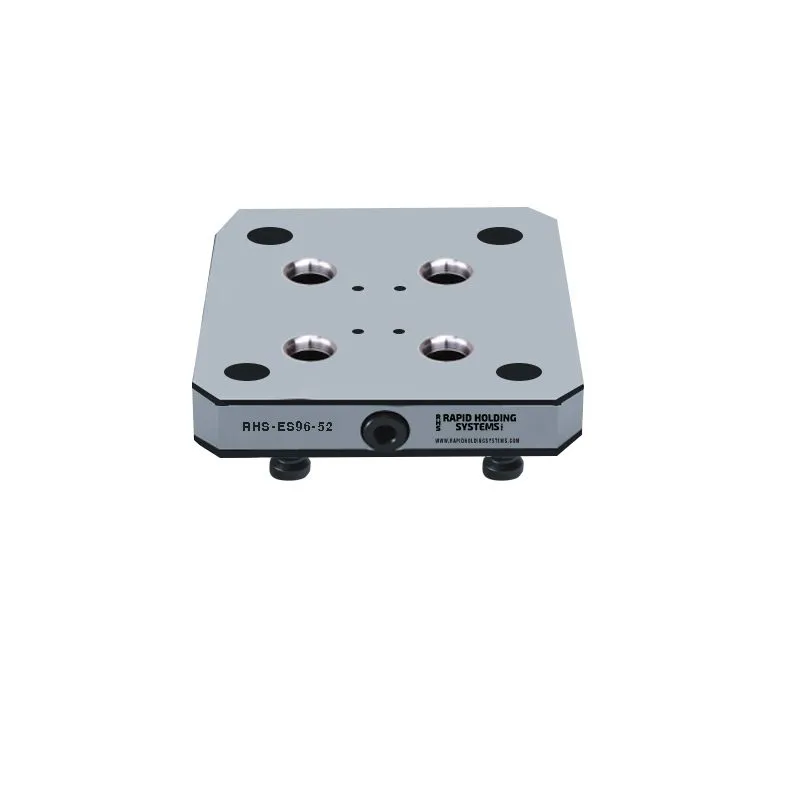
An example is described as an “8-hole zero-point quick-change system” that’s manually clamped and built for rapid locking and high-precision positioning. The most practical feature: it supports two locating hole patterns on the same master plate:
This matters because it makes the master plate a platform, not a single-purpose component. You can run smaller setups on 52 mm workholding and still accommodate larger 96 mm fixtures—without changing the base system.
Why Dual-Pattern Compatibility Improves Scheduling
In real shops, you’ll often have:
- small precision parts that fit comfortably in compact vises,
- medium workpieces that need more clamping footprint,
- occasional round parts better suited to a three-jaw chuck.
The master plate is explicitly described as supporting quick switching between fixtures such as D52 vises, D96 vises, and various-sized three-jaw chucks, especially when machining different workpiece sizes—reducing interference and improving efficiency. In other words: you don’t redesign your workholding every time the job changes. You switch the “top-side” fixture while keeping the “bottom-side” location constant.
Key Specs That Matter in the Real World
A master plate isn’t just about repeatability; it’s also about load and durability. The description lists:
- Bearing capacity: 200 kg
- High repetition accuracy: 0.005 mm
- Up to 90% less set-up time
- Positioning and clamping in one operation
That 200 kg bearing figure is particularly useful in production planning: it tells you the master plate is intended for more than tiny benchtop parts. It’s built to be a real “machine-table foundation.”
A Practical Workflow: How Shops Actually Use This
Here’s a realistic way to build a workflow around a dual-pattern master plate:
Step 1: Standardize your pull studs
If you want fast swaps, standardize stud placement and torque practice across fixtures. Using the correct pull studs (5th axis vise ) is central because the master plate’s locating holes are designed around those patterns.
Step 2: Put your “frequent flyers” on dedicated plates
Your most common fixtures should be “always ready.” Don’t disassemble them; store them assembled and labeled.
Step 3: Use manual clamping for flexibility
Manual clamping is especially good when:
- you move fixtures between multiple machines,
- you don’t want to manage pneumatics,
- you want a simple training model for operators.
Step 4: Reduce interference by choosing the right fixture size
The description calls out minimizing machining interference when you can switch between different fixture styles for different workpiece sizes.
This is one of the most underrated benefits: sometimes the “best” fixture is the one that gives tool clearance without heroic CAM tricks.
Where the 8-Hole Concept Helps Most
1) Mixed product lines
If you run many SKUs across a week, your setup frequency is high. Fast swaps matter more than shaving a few seconds off cycle time.
2) Prototype + production hybrids
If your shop does both prototypes and small production, you need to bounce between setups constantly. A master plate makes that switching less painful.
3) Multi-fixture experimentation
When you’re still developing a process, you might test two different fixtures for the same part. With a master plate, those experiments don’t cost half a day each.
Common Setup Checklist (So Repeatability Stays Repeatable)
- Clean interfaces (master plate + fixture underside)
- Verify pull studs are seated and consistent
- Use consistent tightening procedures for manual clamp
- Label fixtures with their intended hole pattern (52×52 vs 96×96)
- Store fixtures to protect the locating features
When people say “zero-point didn’t work for us,” it’s often not a system problem—it’s a discipline problem.
Bottom Line: One Platform Enables Many Fixturing Strategies
A dual-pattern, manual master plate approach is popular because it gives you most of the time savings of a zero-point ecosystem, without requiring pneumatic infrastructure. The combination of 52×52 and 96×96 locating patterns, 0.005 mm repeatability, and 200 kg bearing capacity makes it a practical “shop foundation” concept.