Shopify is a visual-first platform — before customers read a single word of a product description, they’ve already judged a store based on the quality of its images. That’s why more Shopify sellers are turning to AI product photography for Shopify to create professional visuals without the cost of traditional photoshoots. But with so many options available, choosing the best AI product photography software for a particular store can feel overwhelming.
Why Shopify Stores Need Great Product Photography
Unlike marketplaces like Amazon, where customers compare listings side by side with heavy text focus, Shopify stores rely almost entirely on brand presentation. Product images are often the single biggest factor in whether a visitor trusts a store enough to buy.
AI product photography for Shopify lets store owners upload simple product photos and generate studio-quality images optimized specifically for Shopify listings — at a fraction of the cost and time of a traditional photoshoot. Shopify recommends square images with a 1:1 ratio at a minimum of 2048 x 2048 pixels to ensure high-quality zoom functionality on product pages, and AI tools can produce images that meet this standard automatically.
This approach is especially valuable for brand-new stores with no photography budget. New stores benefit the most, since AI photography solves the classic “chicken and egg” problem of needing professional photos to build trust and generate sales before there’s enough revenue to afford a professional shoot. Clear, accurate product visuals also help set correct customer expectations before purchase, which can meaningfully reduce return rates caused by products not matching their photos.
What Makes the Best AI Product Photography Software?
The best AI product photography software prioritizes realistic lighting and shadow rendering, automatic background removal, bulk or batch processing for large catalogs, consistent style presets, and export formats optimized for Shopify.
Bulk processing matters especially for stores with dozens or hundreds of SKUs, since it allows an entire catalog to be processed at once instead of uploading products one at a time. Output resolution is equally important — the best software exports high-resolution images, ideally up to 4K, so product pages look sharp even when customers zoom in.
Top-tier tools also let sellers save a specific background, lighting, or style preset and apply it uniformly across an entire catalog, keeping a store visually cohesive as it grows. ProductProAI is built with Shopify-ready output in mind, offering a simple upload-and-generate workflow along with correctly sized, high-resolution images that are easy to add directly to product listings.
Getting Started with AI Product Photography for Shopify
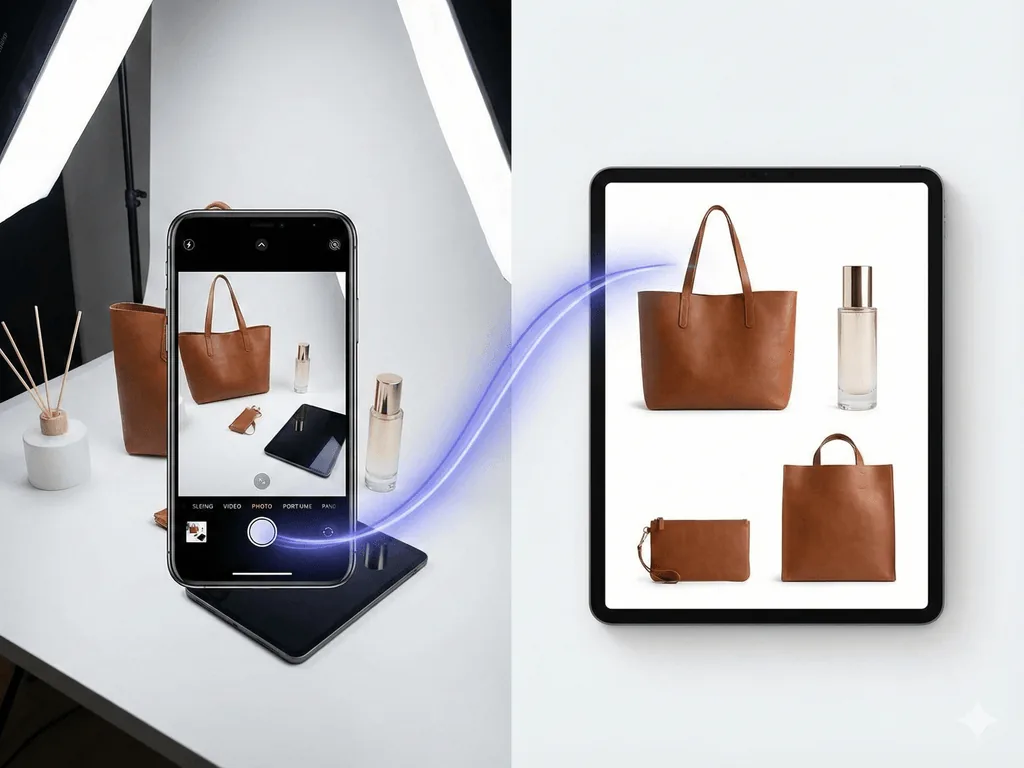
The process starts with a clear, well-lit photo of the product — even a smartphone photo works — taken against a plain surface. That photo is then uploaded to the chosen AI photography platform, where a background or style is selected and the software generates a finished, Shopify-optimized image within moments.
No developer is needed to integrate this with a store. Finished images are simply downloaded and uploaded directly to Shopify product pages, exactly like any other image file. Most platforms also allow multiple style variations to be generated quickly, making it easy to test which visuals perform best with a given audience. Reusing the same style preset across new product uploads helps keep an entire Shopify store looking cohesive and professional as the catalog grows.
Costs and Practical Considerations
Pricing for AI product photography for Shopify usually ranges from a few cents to a few dollars per image depending on the platform and plan — dramatically cheaper than a traditional shoot, which can cost hundreds of dollars per session. Some platforms charge extra for high-resolution downloads or large bulk batches, so it’s worth reviewing pricing tiers carefully before committing to a plan.
Most platforms operate on a subscription or credit-based model, since sellers typically need new images periodically as their catalog grows or their branding evolves. For most small stores, this cost is significantly lower than what they’d otherwise spend on even a single traditional photoshoot, while producing enough images for an entire catalog.
Common Questions and Concerns
With quality software, most customers can’t tell the difference between AI-generated and professionally shot images, since the goal of the best AI product photography software is photorealism rather than an obviously artificial look. Sellers generally retain full usage rights over images generated from their own product photos, though it’s worth confirming this with whichever platform is chosen, including ProductProAI.
The most common mistake Shopify sellers make with these tools is uploading low-quality source photos. Since the AI builds on the original image, a blurry or poorly lit starting photo will limit the quality of the final result. Traditional photography still holds value for hero brand campaigns or unique creative storytelling, but for everyday catalog and listing photos, AI software is now more than capable of meeting the standard.
Final Thoughts
Choosing the best AI product photography software for a Shopify store comes down to matching specific needs — catalog size, budget, and desired style — with a platform that delivers consistent, high-resolution, realistic results. As competition on Shopify continues to grow, sellers who invest in strong AI product photography are giving themselves a clear visual advantage over stores still relying on outdated or inconsistent images.